


Monday, February 4, 2013
Teaching Active Listening to Children
 Listening is defined as a way of communication that involves hearing, interpreting, and constructing a meaning as a learner. ‘Listening’ to something and ‘hearing’ something is two different concepts. For instance, we hear so many things around us such as birds chirping, refrigerator humming, baby crying, cars honking etc but these sounds does not mean that we recorded in our brains.
Thus, it sounds pivotal that we teach our children listening skills by reading to them everyday, and training them in the art of active listening. The studies on listening skills have identified five stages for active listening e. g. receiving, understanding, evaluating, remembering, and responding.
So keeping the importance of active listening in mind, we need to be good listeners as parents. If we model active listening skills, children will always follow that pathway. So let us demonstrate active listening skills and be a role model for our children.

Sunday, January 27, 2013
Developing Reading Skills
 Providing age appropriate attractive books with lots of illustration and colors is an essential part for developing reading skills in children. The illustration enables children to relate the names with the real objects seen in their surroundings. Thus the illustration and the real objects make a good sense in remembering the names of fruits,shapes,vegetables,animals,birds, plants and the surrounding environment etc. It gradually helps them to develop their vocabulary. As they grow up, they need to be provided flash cards with words to associate the names with the objects. It will help them to relate the word and the sounds with the objects. Furthermore, they also need to be provided images, sounds and letters. It will help them to think, relate, associate and make a meaning for themselves. Once this taste is given to the children, it will enable them to explore and search for similar sounds,alphabets and shapes. These kinds of activities help them to enjoy and imagine the words,the sounds and make relationship with each other. It means, children need illustrated and colorful books from the first year of their lives to develop their reading skills gradually.

Sunday, January 13, 2013
Language Development  Early years of language development is the most crucial and significant part in children’s lives. So providing them a multiple environment enables them to learn languages faster. They hear the pattern of the languages; keep storing the words and pronunciations in their brain, trying to make connections in their brain, and producing the language according to their requirements. Research indicates that the children, whose parents come from different culture and background, can develop their language skills faster because they get exposure to two different cultures and languages. The rich experience generates motivation and curiosity for learning the languages. So they try, exploring and practicing the language. The process forces them to express their feelings, ideas, thoughts and expressions. Keeping the importance of language development in children, adults need to keep talking to the children, probing, explaining, sharing their perspectives and relating with children’s experiences so it could make a meaning for them. Similarly, children also need to be provided with opportunity to work with their age fellows and friends. Moreover, resources like story books, toys and learning materials create a momentum in their thinking and expressions of languages so they need to be provided with all these resources so they could develop their language skills.

Friday, January 4, 2013
Child Discipline
 Disciplining children is always a challenging job for parents. It frustrates, irritates, fluctuates and demonstrates emotional behavior. In many cases, we as parents cannot control ourselves in hitting our children for the misbehavior, particularly, in our third world countries like Pakistan and Afghanistan etc.
The question arises, that when to teach discipline? What are the strategies that we (parents) can use it in disciplining our children?
Well, the foundation to disciplining children is differentiating between, ‘Dos’ and ‘Don’ts’ from 9 to 10 months of age onwards. Here are few tips to keep in mind in disciplining our children;
1. Do tell and show our love to our children but do correct their behaviors politely and respectfully
2. Do set our standards but avoid high expectations
3. Do set limits and be fair enough to demonstrate our love.
4. Don’t let down our guard about safety. We might be teaching our children that the stove is hot or the stairs are steep, but don’t count on them to avoid temptation.
5. Do take personality into account because some children need a firm tone of voice, while others respond better to a gentler one.
6. Don’t shame or criticize. Calling name is always hurtful because it can crush children’s developing self-confidence.
7. Do be consistent because it requires a lot of patience
8. Don’t always say, ‘No’ because it gives a message to our children that we are powerless.
9. Do catch them being good. Praise their good behavior like offering a toy to a friend or helping us for small tasks. Highlighting the positive behavior is truly powerful.
In order to promote self discipline or disciplining children, we need to teach them what to do and what not to do? They should also know the reason why they should do or shouldn’t do. If this happens, child discipline can be an easier task for parents.

Thursday, December 27, 2012
Effective Parenting
 The more research and exploration goes on regarding early childhood education, the same parenting has been becoming harder and challenging.
Children are born with natural abilities. They have the potential for growth and development socially, mentally, physical, emotionally and morally. So parents’ parental skills help them to grow faster because the millions of neurons in their brains become active if they are provided a good nurturing environment.
Therefore, parents’ parental skills need to be equipped with current knowledge, skills and attitudes in dealing with their children. They need to be aware of their physical, social, emotional and intellectual needs to deal accordingly. Here are few tips for effective parenting;
• Have a gentle positive approach to work with their children
• Provide nutritional food, including all groups of food
• Set a routine for breakfast, lunch, dinner, play & fun time, wash and bath time
• Have some time on weekends & vacations to give them exposure to the environment and people in a different environment
• Provide age appropriate toys and books
• Engage them in meaningful activities
• Develop a peaceful environment at home to develop their self esteem and self confidence

Wednesday, December 12, 2012
Children’s Positive Behavior
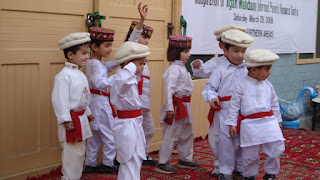 Children are great imitators. They form their behavior based on the pattern of behaviors that they come across in their daily life. They begin imitating the behavior of adults when they see them behaving in certain ways. In our real lives, we might have come across lots of examples, that when we have praised or scolded someone in front of children, they might have acted in the same way.
Therefore, it’s significant for parents and families to demonstrate a positive behavior in front of their children. For instance, when children talk or share their small successes or challenges, we ignore or node heads as we are listening but actually we don’t. This gives a message to the children that their point of view is not important. So they learn not to listen to others or ignore in the same way that they have come across.
In order, to promote a positive behavior, we need to reinforce the following behaviors;
1. Listen to children and respond according to their needs (social, physical, emotional and intellectual)
2. Praise for small successes and support in solving miner problems.
3. Give a big smile and hug
4. Talk politely and friendly
5. Say, ‘Thank you”, ‘please’ and ‘Excuse me’ when we receive or give something.
6. Avoid discussing others in front of children
If we follow these small rules, it will generate positive thoughts and images in children that will lead to generate a positive behavior in children.

Friday, November 30, 2012
Child Development & Home Environment
Child Development & Home Environment
The conception of child in a mother’s womb is a critical stage for his development, as brain development begins right from the start.
The fertilized egg goes through three phases of development, first trimester, second trimester and third trimester, and begins to take a physical shape of a child very rapidly.
 By the second trimester, the eyes, mouth, nose, and ears are almost completely formed. By the fifth month, the baby’s senses are developed and he can begin to hear his mother’s voice and other familiar voices. The baby is ready to learn. The mother should interact and talk and read to her prenatal baby. It is interesting to note that the baby is never born as a blank slate. He is constantly picking up information and storing it in his brain. The way parents interact with the baby even before he is born has an impact on the development of the child later in life. A confident person trusts himself because he knows that he has been wanted and loved from the time he was conceived. Communicating with the unborn child provides the stable, supportive environment that every child needs in order to learn and grow and to become a child who is optimistic, confident and with a good demeanor.
He can sense his mother’s emotions and this has an impact on his brain. The mother’s nutrition is also very critical to the fetus. Family members play a crucial role in their interaction with and care for the mother. They need to make her feel cared and respected so she can have a peaceful mind throughout the experience. They should try and keep her content, make her feel respected, and ensure that she is nutritiously fed at all times.
Remember peace building begins from the child’s conception and sustains throughout his life! If he experiences a peaceful environment from conception and after birth, he is more likely to have a well-balanced emotional growth and grow up to be a peace-loving adult.
Another important point to consider is that we need to think and reflect before partnering two lives (man and woman) together. It’s not only partnership or one’s marital status in a society, but rather it has a bigger meaning for the future. The union through a marriage that brings forth a child needs to have a strong basis for a child’s holistic development and a strong foundation for a strong future. However, this can only be possible if the home environment is safe, peaceful and conducive for a child’s growth for a peace-loving mind set in a peaceful society.
Written by: Safida Begum

Subscribe to:
Posts (Atom)